|

City ordinance prohibits hunting and trapping in Rolland F. Perry City Forest. City ordinance also prohibits the discharge of firearms in the surrounding area, including the Walden-Parke Preserve, and requires written landowner permission in the zone including the Northeast Penjajajwoc Preserve. The Bangor Land Trust prohibits hunting and trapping in Walden-Parke Preserve. Notwithstanding restrictions on hunting and trapping in this area, this area is heavily used by the general public for recreation.
Beaver
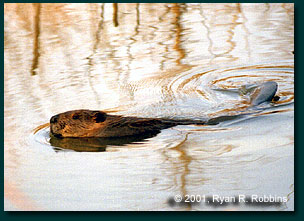 No animal has had a greater impact on the land surrounding City Forest than the beaver. The nearby Penjajawoc Marsh owes its existence to this rodent, which has an innate desire to stop running water by creating dams.
The beaver is 27-35 inches long with a tail up to 15 inches long and 7 inches wide. An adult weighs anywhere from 28 pounds to 75 pounds. Its diet consists of leaves, buds, twigs, fruit, ferns, aquatic plants, and bark.
Beavers live in a large lodge they build using wood from the trees they cut and mud. A lodge can have several rooms – including a “bathroom” – and is almost impenetrable from outside predators, which include the coyote, bobcat, fisher, and black bear. Although the river otter poses the most serious threat to the beaver because it can swim into the beaver’s lodge, it is not unusual for the black bear to prey on a beaver if the opportunity arises, as beavers are most vulnerable on land. In summer 2008, the remains of a young beaver were found on the Veazie Railroad bed at a site where black bears were known to feed on berries.
With a body suited for working in the water, the beaver can remain submerged for up to 15 minutes without needing to come up for air. Its fur is waterproof, its feet are webbed, flaps help protect the nostrils and ears while underwater, and dual eyelids help the animal see underwater.
Where to find it: at the base of the former landfill, between the arboretum and Main Road; and along the Veazie Railroad bed.

Porcupine
 A large rodent, the porcupine’s main body is between 18-23 inches long while its tail is an additional 6-12 inches long. The animal weighs anywhere from 10 pounds to 28 pounds. It is nocturnal, emerging at about sunset. It makes its den in hollow logs, under tree stumps, in caves, and even in abandoned dens of other animals. Its diet consists of plants, seeds, leaves, evergreen needles, bark, and twigs.
It is a myth that a porcupine can throw its quills. It defends itself by swatting an aggressor and releasing the quills that embed themselves into the skin of the aggressor. An adult porcupine has up to 30,000 quills that can be up to 4 inches long each. The porcupine’s predator is the fisher, which subdues the porcupine by hitting it in the face and flipping the stunned animal over for the kill.
The porcupine scours the forest floor for food, but will scamper to the nearest tree at the first hint of danger. When on the ground, it ambles along slowly, keeping to itself. In a tree, it is a quiet yet quick climber.
Where to find it: along the old Veazie Railroad bed, along Loop Road, along Shannon Drive, the arboretum, and along West Trail.
Snowshoe hare
 The snowshoe hare, so named because of its large, snowshoe-shaped hind legs, thrives along with porcupines in City Forest. An adult’s body is 17 inches to 20 inches long, with the tail being a mere 2 inches long. The hare weighs 4 pounds to 4 1/2 pounds, on average. In the spring, summer, and fall, its fur is brown, with some white on its chest and stomach. In the winter, the fur turns white to help the hare blend in with the snow.
Its diet consists of vegetation: grass, clovers, dandelions, ferns in the spring and summer; and evergreen needles, bark and twigs from birch, willow, and aspen trees in the fall and winter. It will even ingest its own scat to get any nutrients not digested by the body the first time.
The mating season lasts from March through July, with a gestation of only 36 days. A female can produce up to three litters a year. Newborns nurse for four weeks, after which they can fend for themselves.
Snowshoe hares prefer densely wooded areas with lots of tree cover; they nest in a shallow depression. They can run up to 30 mph and leap up to 12 feet at a time, although they tend to hop in 3-foot to 6-foot increments.
Predators include the bobcat, coyote, fox, mink, lynx, fisher, and owl.
Where to find it: along the Veazie Railroad bed, Loop Road, the arboretum, between Main Road and the beaver ponds, and even the Tripp Drive parking lot.
Canada goose
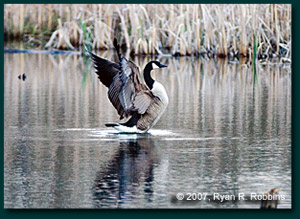 You’ve probably seen Canada geese from afar, flying in a large “V” formation at the beginning of the fall as they migrate south for the winter. Up close, the Canada goose can be quite large, such as this one spotted at the beaver pond next to the arboretum in spring 2007. Not all Canada geese are large, though, as their size can vary greatly, with some as small as 22 inches long and others as large as 45 inches long, with a wingspan ranging from 5 feet to 6 feet. The size variation is due to the bird having 10 subspecies. The smallest is the Cackling Canada Goose, and the largest is the Giant Canada Goose.
The tell-tale sign of the Canada goose is the white “chin strap” that highlights an otherwise black head and neck.
The bird’s diet consists of aquatic plants, insects, grass seed, and crops. Its predators include the great-horned owl and meat-eating mammals. Snapping turtles will eat young ones.
The mating season lasts from March through April, with pairs mating for life. Newborns hatch about 30 days after their parents mate. They leave the nest, which can be found above the ground near the water, at about 45 days.
Some Canada geese migrate as far as 4,000 miles.
Where to find it: beaver pond next to the arboretum
Mallard
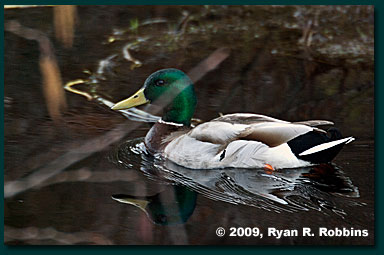 Probably the most commonly recognized water bird around City Forest, the mallard can be found anywhere there is enough water for it to swim in: the beaver pond next to the arboretum, Dixon Brook next to Loop Road, and any of the pools created by beavers along the Veazie Railroad bed.
The male features a green head and dirty yellow beak while the female is a dark, sometimes mottled, brown with a darker, more orange bill. Mallards range in size from 20 inches to 23 inches long, with a wingspan up to 36 inches. Their diet consists of aquatic plants and insects, grass, seeds, and grains. The fox, skunk, and coyote prey on the mallard’s eggs while the snapping turtle and large fish prey on newborns.
The mallard’s mating season begins in April and lasts through July, with pairs coming together in the fall. Newborns hatch from their eggs about 30 days after their parents mate, are able to swim immediately, but cannot fly for about 60 days.
Mallards nest on the ground. They are shy, so they often fly away with rapid “quack-quack-quacks” when surprised or approached too closely.
Where to find it: beaver pond next to the arboretum, Dixon Brook on Loop Road, along the Veazie Railroad bed.
Barred owl
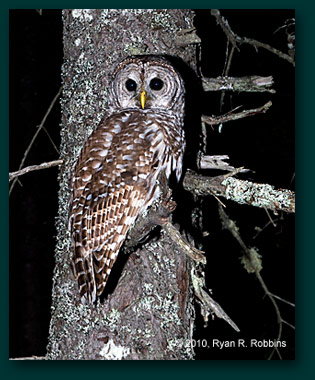 Deriving its name from its bars of white and grayish plumage, the barred owl is smaller than its more fearsome cousin, the great horned owl. In fact, the barred owl is sometimes prey for the great horned.
The barred owl is about 17-24 inches long and weighs about 12-23 ounces. The species mates from February to April, with two to four young born within 28-33 days. The young leave the nest at about 3 to 4 months of age.
When hunting, the barred owl uses keen senses of sight and hearing to home in on prey, which include small rodents, such as mice, voles, squirrels, frogs, and small birds. The barred owl’s right ear is a bit higher than its left ear, enabling the bird to better locate prey by sound.
The owl hunts at night and flies silently from tree limb to tree limb, where it will perch and stand stoically, watching and listening for prey to appear. A barred owl’s call can sound similar to a dog barking in the distance.
Where to find it: Barred owls have been seen on West Trail and Main Road in City Forest.
Black bear
 With the distinction of having no predators other than itself, the black bear is one of the most elusive mammals in City Forest.
Black bears are born after a 60-day gestation period that comes after a five-month delay after mating, which occurs in June and July. Cubs, which are born blind, are usually born as twins. They have no hair and are about 8 inches long while weighing only 8 ounces. They open their eyes at about 40 days old and nurse from their mother in the den through winter. In the spring, the cubs emerge with their mother. At 18 months, cubs are on their own.
A black bear’s den can be found in brush piles, under uprooted or fallen trees, or in hollow logs.
As an adult, the black bear is between 4 ½ feet to 5 feet long, standing 2 feet to 3 feet high at the shoulders, while weighing 120 pounds (female) to 300 pounds (male). Despite its compact and robust size, the black bear can run up to 25 mph, easily outrunning a person on foot or even on bike. Its coat ranges from a dark brown to black.
The bear’s diet consists of acorns, nuts, roots, berries, insects, mice and other small rodents, fish, and garbage. It particularly enjoys eating bee larvae and honey and will rip nests apart to get food. The bear’s thick skin protects it from stings.
Except for humans, the black bear’s only predator is itself, as adult males have been known to kill cubs. The black bear’s habitat includes forests and wetlands.
Where to find it: Anywhere in City Forest; along the Veazie Railroad bed; Walden-Parke Preserve; Northeast Penjajawoc Preserve, Orono Bog.
White-tailed deer
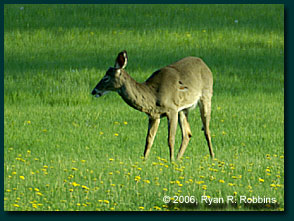 The forest’s increasingly popularity in recent years has all but driven the white-tailed deer from the boundaries of the park. You’re most likely to catch a glimpse of the elusive animal just after sunset or just before sunrise.
The deer’s body is 4-6 feet long with the tail between 6-13 inches long. The shoulders are between 2-3 feet high. Males weigh anywhere from 100 to 300 pounds while females weigh 85 pounds to 135 pounds. The males have antlers that grow in spring and throughout the summer and that are then shed in the winter.
The deer’s summer diet in the forest consists of grass, deciduous vegetation, leaves. In the winter, the animal’s diet consists of acorns and bark from oak, birch, and maple trees.
Predators include the coyote, bobcat, and domestic dog.
Fleet and graceful afoot, the deer can run up to 40 mph and disappear quickly and easily into the environment when surprised by oncoming people.
Where to find it: around Loop Road. Enormous amounts of deer scat have been found northeasterly off East Trail between Bog Brook and Moose Trail. Other evidence of deer activity includes flattened grass, where deer have slept, and scrapings on trees, where deer have either eaten the bark or males have marked their territory during mating season, which is from October
to January.
Raccoon
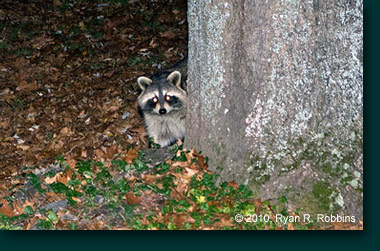 Seldom seen in daylight, the raccoon comes out as darkness falls. It prefers living near brooks and streams and other wetlands, where there is an abundance of frogs, salamanders, crayfish, worms, small fish, and turtles and their eggs. It will even eat immature muskrats. The raccoon also likes nuts and berries. In residential areas, it will raid garbage.
Contrary to popular belief, the raccoon does not wash its food. It will submerge berries and nuts in water to soften the skin and make the food easier to eat by filtering out indigestible matter.
The raccoon is a relative of the black bear and an adept climber. Unlike, the black bear, however, the raccoon does not hibernate in winter, even though its food intake decreases during the snowy months. More than 30 percent of the raccoon’s body weight is fat, enabling the animal to make it through lean times.
Mating season is from January through March. A litter of one to eight will be born about 63 days later. The mother will teach her young how to hunt and what to eat for several months. Some young will disperse in the fall. Others may remain with the mother until she mates again, when she will push those remaining out to make room for the new litter.
The raccoon makes its nest in vegetation, in trees, culverts, rock piles, and other similarly protected areas.
Predators of the raccoon include the coyote, fox, owl, and bobcat.
Where to find it: Tracks have been found along the Penjajawoc Brook in the Northeast Penjajawoc Preserve, on the bank of Marsh Pond at the southern corner of the Northeast Penjajawoc Preserve, and along the Veazie Railroad bed.
Coyote
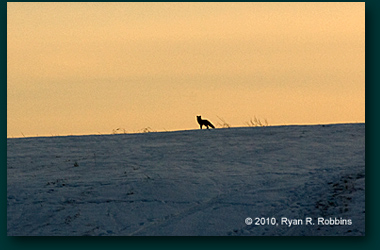 The often unfairly maligned coyote has been making its presence increasingly known around City Forest and the Walden-Parke Preserve in the last couple of years.
The coyote stands anywhere from 2-3 feet tall at the shoulder, is about 3 1/2-4 feet long, and weighs 20-40 pounds. It can be gray to reddish-gray, with erect ears and a bushy tail that it carries down, even when running.
The coyote has no permanent den; it will bed in tall grasses or a thicket shielded from the elements. Mating season occurs from February through April, with a litter consisting of one to nine young. Although the dog doesn’t use a permanent home, a mother will use a den she digs in a hillside, a crevice in an outcropping of rocks, or even a large culvert.
Voles, snowshoe hares, frogs, snakes, squirrels, small birds, and even fruits make up the bulk of the coyote’s diet, as the animal is an opportunistic predator. It may even snatch a beaver that makes the mistake of waddling too far inland. Contrary to popular belief, coyotes do not hunt in
packs. They hunt alone, with the family heading out at about sunset. The father of the clan will announce the hunt with several yelps as the family splits up.
If a member of the clan gives chase to prey, others in the clan may help trap the prey.
The coyote primarily yelps at the beginning of the hunt, when seeking help to trap prey, to declare territory to other coyote clans in the area, and to announce the end of the hunt.
Although many deer hunters accuse the coyote for the state’s dwindling deer population, biologists say deep snow packs in recent winters have done far more to hurt the deer population. Since coyotes first began appearing around the Penjajawoc area a little more than a year ago, the
snowshoe hare population has dropped, but the deer population appears to have increased, with no evidence that any deer in the more than 1,200 acres have been taken.
Where to find it: A coyote was seen atop the capped landfill at the end of Kittredge Road in December 2009; tracks have been seen throughout the City Forest arboretum and throughout the Northeast Penjajawoc and Walden-Parke preserves; coyotes have been heard within Walden-Parke.
Meadow vole
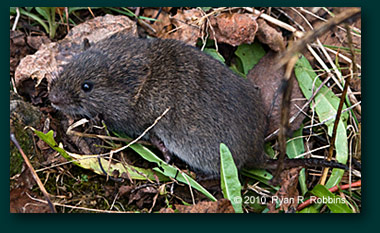 Seldom seen because of its small size and nocturnal circadian rhythm, the meadow vole often leaves plenty of tracks in snow, with its burrowed tunnels also most evident in early spring before grasses and plants grow back.
The vole resembles a mouse. However, it is longer and more slender, with adults growing to between 5 ½ to, in some cases, almost 8 inches long and weighing just under half an ounce to 2 ½ ounces.
The rodent’s mating season begins in the spring and lasts until fall, with females able to produce several litters of up to 11 young each year. The gestation period is only 21 days.
It lives in fields, marshes, and in wooded areas that have sufficient amounts of grass, including clover, and plants. It eats its weight in vegetation daily.
During the day, the vole hides in the safety of a burrow. At night, the animal gets around using a system of tunnels. The tunnels help it elude predators such as owls, hawks, foxes, coyotes, snakes, and bobcats.
Where to find it: There is a large system of tunnels in the City Forest arboretum; tracks have been seen along the Veazie Railroad bed in the winter; actual sightings have been on upper West Trail in City Forest and along Tamarack Trail in Walden-Parke Preserve.
Painted turtle
 Of 56 species of turtles native to New England, the painted turtle is the most abundant. Fully grown, it can be 4-10 inches long, with females larger than males. The turtle gets its name from its bright lower shell, which can be yellow, red, and orange. The upper shell is dark olive-drab. Its diet consists of water plants, insects, crayfish, mussels, worm, carrion, and fish. As a reptile, the painted turtle is cold-blooded, so it regulates its body temperature by sunning itself periodically throughout the day in the spring and summer and burrowing in mud in the fall to sleep away a long Maine winter. The turtle prefers quiet surroundings and relatively still water.
Where to find it: along the old Veazie Railroad bed on banks of marsh water, anywhere there is a fair amount of water.
Snapping turtle
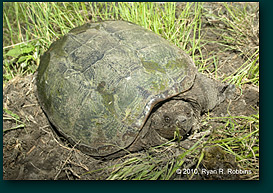 The snapping turtle is the largest kind you will find inland in Maine. It can be anywhere from 8 inches to 20 inches long and weigh 8-35 pounds. Some even weigh more than 40 pounds, although such specimens are rare. The snapping turtle will bury itself in mud and patiently wait for its next meal to pass by, then it will snap at its prey. Its diet includes fish, birds, muskrats, snakes, frogs, insects, aquatic plants, carrion, and even other turtles. A snapping turtle can live as long as 40 years. Predators of adults include otter and coyote. Predators of young snapping turtles include birds, snakes, large fish, and other turtles. Predators of eggs include raccoon, skunk, and coyote.
Where to find it: same places you can find painted turtles. A snapping turtle skull was found on Moose Trail in 2004, a few hundred feet from Dixon Brook.
Great blue heron
 A sight to behold, the great blue heron is the largest, and most graceful, bird you will find at City Forest, with a body between 39 inches and 52 inches long and a wingspan between 6 feet and 7 feet. Yet despite its size, the wader weighs only 6-12 pounds. The bird’s large feet feature four well-spaced toes that enable it to wade in soft mud without sinking. The great blue heron’s diet consists of mice, frogs, snails, crayfish, fish, and insects. Predators of the bird include the great horned owl, bald eagle, and golden eagle.
When feeding, the bird stands still as its eyes scan the water’s surface. When a meal comes into range, the bird jabs at the prey with its long beak and flips the prey into its mouth for quick swallowing.
Where to find it: beaver ponds at the base of the former landfill, along Veazie Railroad bed in the Penjajawoc Marsh.
Downy woodpecker
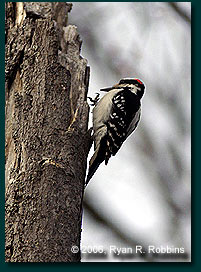 If you hear a quick, repetitive knocking of hard wood high above the ground, chances are you’re hearing a downy woodpecker claiming its territory. The downy woodpecker is the most commonly found one in City Forest. An adult is between 7-8 inches long.
The bird looks similar to its cousin the yellow-bellied sapsucker, but you can distinguish the downy woodpecker from the sapsucker by its all-white chest. The male downy has a tuft of red on the back of his head.
Where to find it: in the trees between the arboretum and Main Road and between Moose and Bear trails.
Pileated woodpecker
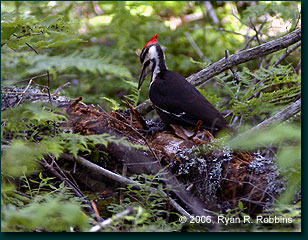 Distinguished from its counterparts with a tuft of red feathers on its head as a crown, the pileated (pilly-ate-ed) woodpecker is the largest woodpecker, with an average length of about 17 inches. Its diet consists of carpenter ants that can be found most often in fallen timber, roots, and rotting tree stumps in softwood forests. To get at the ants, the woodpecker pounds out a rectangular hole about the size of a human fist and then picks up its prey with a long, sticky tongue.
Although you can tell where a pileated woodpecker has been by looking for its trademark pecking pattern, actually seeing this species is a little more difficult, as it is very shy and will fly away quickly.
This woodpecker carves its nest out of a tree’s trunk. The female lays four eggs at a time.
The pileated woodpecker in this photo is a female, identifiable by the narrow band of black feathers on the side of her head. The male has red feathers in that spot.
Where to find it: off Squirrel Trail, near Main Road and Skunk Trail.
Red squirrel
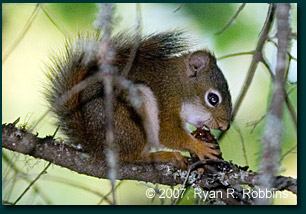 Among the smallest of squirrels, the red squirrel is abundant throughout the forest. It chatters rapidly in high-pitched squeaks when it senses a disturbance in its surroundings. Most of the time this squirrel will be high in a tree by the time you reach it.
An adult weighs no more than half a pound, has a dull-reddish coat on its back, and tan-to-white belly. The tail is wiry but bushy. The red squirrel is smaller than the gray squirrel but larger than its chipmunk cousin.
Its food consists of pine cone seeds. If you see a pile of small cones under a tree, chances are a red squirrel is living nearby. The animal’s nest may be found in the crotch of a tree, the hollow of a fallen tree, a hole in the ground, or a hummock. Mating season is primarily in late winter, with some mating occurring in mid-summer. The female is in heat for only one day, though, and will give birth about 35 days after mating.
Where to find it: throughout wooded areas of the forest.
Chipmunk
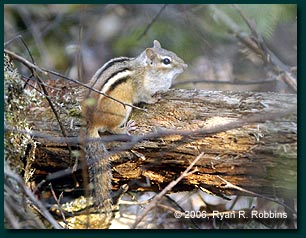 A cousin of the more populous squirrel, the smaller chipmunk is 3-5 inches long and weighs up to 4 ½ ounces. The chipmunk can run up to 15 feet per second. Unlike the squirrel, it prefers to stay on the ground. Its diet consists of nuts, buds, berries, seeds, mice, frogs, insects, and bird eggs. It transports food in its flexible cheeks. You can identify the chipmunk from its squirrel cousins by its small size and its reddish-brown fur coat that features a white stripe between two black stripes on each side.
A chipmunk’s den is underground, usually hidden under roots or rocks. The den features a pantry for food storage, a bedroom, and a bathroom.
Predators of the chipmunk include the coyote, bobcat, fox, owl, weasel, snake, and domestic cat.
Where to find it: along East Trail, Quinn Trail, and anywhere there is deep tree cover and lots of roots or tree stumps. Listen for rapid, high-pitched squeaking, the chipmunk’s signal for possible danger.
Robin
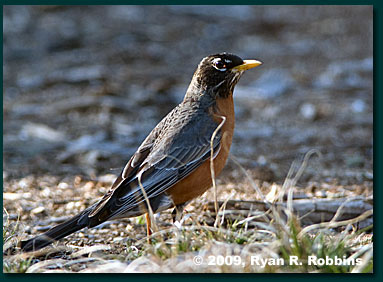 One of the most easily recognizable birds, the robin is 9-11 inches long with a wingspan of up to 17 inches. It weighs up to 3 ounces. Its diet consists of earthworms in the spring and summer. In the fall and winter, the robin searches for fruits and berries. Mating season is in early spring, with
3-5 eggs per brood. The eggs are light blue. Males have a red chest while females have a pale red chest.
One of the most easily recognizable birds, the robin is 9-11 inches long with a wingspan of up to 17 inches. It weighs up to 3 ounces. Its diet consists of earthworms in the spring and summer. In the fall and winter, the robin searches for fruits and berries. Mating season is in early spring, with
3-5 eggs per brood. The eggs are light blue. Males have a red chest while females have a pale red chest.
Where to find it: at the arboretum, Orono Bog, along Veazie Railroad bed.
Red-winged blackbird
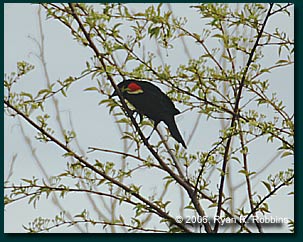 The red-winged blackbird is plentiful at the forest’s arboretum and throughout the marsh land created by the beaver. The bird likes to rest atop the cattails throughout the marsh land, but it will perch high in the trees surrounding the arboretum.
Fully grown, it measures 7-9 ½ inches long with a wingspan of up to 16 inches, and weighs up to 3 ounces. Its diet consists of seeds, insects, and grain.
While the male red-winged blackbird appears as named, the female is actually brown with no red.
Where to find it: at the arboretum, Orono Bog, along Veazie Railroad bed.
Garter snake
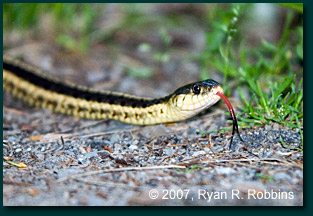 About 26 inches long when fully grown, the garter snake is probably the most commonly found snake in Maine. Its habitats include the forests, marshes, swamps, ledges, and fields – just about anywhere. The snake’s diet consists of insects, worms, fish, frogs, toads, salamanders, young birds, rabbits, and mice. It’s able to consume the latter portion of its diet by expanding its jaw and swallowing its prey whole.
The garter snake has no eyelids or ears; its skin is rough and scaly. Females are larger than males.
Predators of the garter snake include owl, hawk, skunk, fox, coyote, raccoon, and domestic cat. When threatened, the snake secretes a bad-smelling liquid.
The snake hibernates during the colder months, but it may emerge on particularly warm winter days.
Where to find it: just about anywhere, with sightings mostly on the western side of the forest.
Northern leopard frog
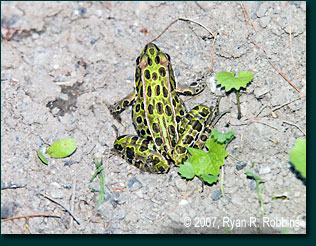 Although the northern leopard frog makes its home in cool ponds, streams, and brooks, you can often find the species far away from water in the summer. As a full-size adult, this frog can be as long as 3 ½ inches. Its coloring can range from light to dark brown or green, with darker pigment forming spots that have a light border. It also features a white stripe along its jaw.
Mating season begins in March, soon after the frog emerges from a deep winter sleep, and lasts through June. The female lays her egg masses on the bottom of ponds, streams, brooks, or vernal pools, or she attaches them to submerged vegetation just below the water’s surface. The eggs will hatch within 20 days, with the resulting tadpoles quickly maturing into adults by August.
The species can darken its color to blend in with its surroundings when in heavy vegetation. Its pale underbelly helps it to avoid detection from larger fish when in the water.
The frog’s diet consists of insects, spiders, leeches, and snails. Predators include fish, other frogs (including its own species), raccoon, mink, great blue heron, hawk, snakes, large salamanders, skunk, and sometimes black bear. The species tries to escape capture by leaping as much as three feet at a time in zig-zag patterns.
Where to find it: Bog Brook, beaver pond at base of former landfill, along the Veazie Railroad bed, vernal pool along Rabbit Trail, and just about anywhere in the forest during the summer.
Great horned owl
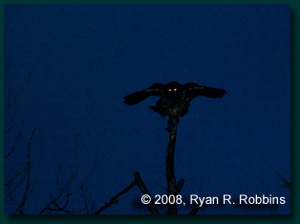 One of the most elusive birds to be found in the Penjajawoc Marsh region, the great horned owl is a sight to behold if you are so lucky. Chances are you have probably heard its calls around sunset in the fall.
The great horned is the largest owl in Maine, measuring between 18 inches to 25 inches in length with a wingspan between 36 inches to 60 inches. It weighs but 2-4 pounds, though. Plumage varies from reddish brown to off-white, grey, or even black, with mottled colors. The species gets its common name from its two large tufts of feathers atop its head that resemble horns.
The bird comes out near sunset and perches atop dead trees, lying in silent wait for prey to emerge. When the prey emerges or arrives, the owl swoops down in complete silence and makes quick work of its victim. Prey include frogs, fish, field mice, shrews, moles, voles, squirrels, skunks, bats, other birds, and even snowshoe hares. Death at the talons of the great horned is instant as it snaps its prey’s neck.
The great horned owl does not build its own nest. It uses nests abandoned by other birds. It will sometimes use squirrel nests. Mating season occurs in January and February, with the female laying two to four eggs that will hatch 26-35 days later. The young ones will leave the nest for good in the fall. Mating pairs will remain in the same territory for as many as eight years, but they stay together only during mating season.
The great horned’s life expectancy in the wild is about 13 years. Predators include the northern goshawk and peregrine falcon.
Where to find it: Northeast Penjajawoc Preserve, Walden-Parke Preserve.
Wild turkey
 You would have been hard-pressed 25 years ago to find any wild turkeys in what is now City Forest and the surrounding Bangor and Orono land trust holdings. That’s because the wild turkey had been eliminated from the Maine landscape. After decades of failed reintroductions of the bird using domestic turkeys bred with wild turkeys from other states, biologists finally succeeded in reintroducing the large bird into souther parts of the state by moving in wild turkeys from Vermont and Connecticut in the late-1970s.
As the reintroduced turkeys bred with one another, biologists gradually moved the turkeys northward in the mid-1980s.
Female wild turkeys stand about 3 feet tall and weigh 8-12 pounds while males stand up to 4 feet tall and weigh up to 20 pounds. Mating season is in April and May, with males putting on a show for females. Females nest in a shallow depression at the base of a tree and will lay an egg a day for up to 12 days. The young hatch 26-28 days later. At 5 to 6 weeks of age, the young are able to fly and will seek refuge in trees.
Adult turkeys can fly up to 60 mph and are fleet afoot as well.
The wild turkey’s diet consists of insects, grasses, seeds, nuts, and fruits, which they often find in fields. Males – called toms – stick to themselves, except during mating season, when several may gather for the attention of nearby females – called hens. Females travel with their young and congregate with other hens and their young. These groups can consist of a handful of birds to as many as 50.
The wild turkey is most vulnerable to predators when young or incubating eggs. Coyotes, foxes, raccoons, bobcats, and fishers will go after young and incubating mothers. Crows, skunks, and red squirrels will go after eggs.
Once a wild turkey reaches adulthood – males especially – the bird can live as many as 10 years, according to the Maine Department of Inland Fisheries and Wildlife.
Where to find it: Along the Veazie Railroad bed, along East Trail in City Forest, and in fields surrounding the area.
| 